
We have been laying hedges for thousands of years, to keep livestock in, unwanted grazers out, to act as barriers and boundaries.
Hedges were traditionally kept in check by the farm labourers in the quieter seasons of autumn and winter, when they would repair holes, patch up the weak areas and trim them to shape with handtools.
Over time, different styles developed depending on the area of the country, and what the hedge was to be used for.
A hedge for sheep, in the south of England, would be a different shape to a hedge for cattle in the midlands, or a hedge to protect the top of a bank in Devon.
Then, as mechanisation came in in the 20th century, and labourers left the land, hedges were grubbed up to make larger fields, and together with the hedges, the skills died out.
Now, with an increased awareness of conservation, and increased interest in the return of rural crafts, and the need to manage our environment better, hedgelaying has returned and interest has increased.
The skill and craft of hedging is in the clearing, cutting and binding.
It is said that a hedge should only be laid when there is an R in the month, but as the climate shifts, the season is becoming shorter, with most laying between October and March.
To start, one clears the underside of the hedge, removing the bramble, deadwood, detritus and any other rubbish that has accumulated. You then clear along and remove any of the significant wood that may not be used during the laying process.
Once the hedge is clear and access easier, then laying can begin. A stem is selected and cut carefully, so that it can lay over at the desired angle. When cutting it is vital not to go all the way through, but to leave some sapwood and bark (often 30% of the width) to allow the stem to continue to grow. Judging this width is often the art.
Once a number of stems have been pleached (the name of the cut), then they can be woven carefully around an upright stay, often cut from the hedge or a coppice, to add structural stability.
After a length has been laid, and if the style dictates, then the top of the stays can be woven and bound to further increase the strength of the new hedge.
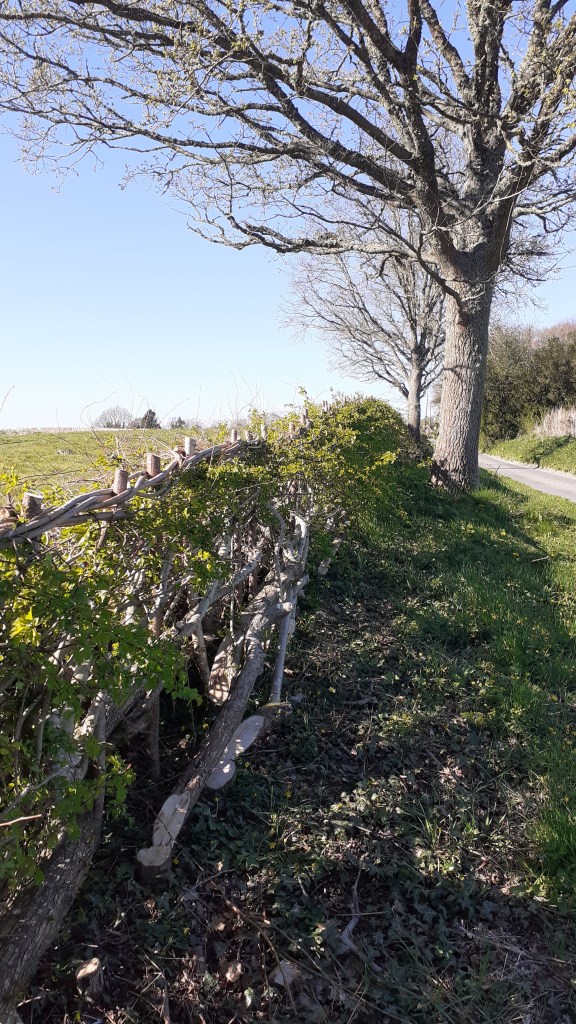
In the above photo, you can see the pleachers where they have been cut and laid, the upright supports, and the twisted hazel binders, all joining together to create a strong, nautural boundary. As this hedge was laid a year before the photo was taken, you can see the regrowth already taking place, which will ensure the ongoing life of the hedge for another 20 years at least.
 flyingduckgoods.co.uk
Leave a comment